Friday, October 20, 2023

Gio-ing Deep: Notes from NFL Week 6 2023

It was nice to see Drake London and Jakobi Meyers have nice games following last week's post, and Zach Evans might even be the Rams' new starting running back now after I gave him a shout, as well.

Now here are some other observations from this past week with the usual citation that snap counts are from Pro-Football-Reference.com; targets, carries, and PPR fantasy points data are from ESPN; and routes run and average depth of target (aDOT) are from PFF as listed on FantasyLife.com.

  • Week 6 started on TNF with the most frustrating game yet for rookie wide receiver Marvin Mims, who had a season-low snap rate of 23.08% and failed to see a target for the first time in his young career. Journeyman Lil'Jordan Humphrey was cut during the week and still played more snaps than Mims (after being re-signed to the practice squad and elevated for the game) despite the rookie being the team's most explosive playmaker. He's had catches of 60 yards (a touchdown), 53 yards, 48 yards, 38 yards, and 30 yards along with a 99 yard kickoff return TD and punt returns of 45 yards and 25 yards. Despite this, Mims has played only 27.32% of the snaps and run routes on 26.48% of the team's dropbacks, resulting in just a 7.06% target share. Consistently putting Brandon Johnson and sometimes Humphrey out there instead is some criminal coaching by Sean Payton for the 1-5 Broncos, especially after they traded up to get Mims in the 2nd round as the first selection of his tenure. It does feel like only a matter of time before Jerry Jeudy gets traded, so maybe then the rookie will finally be unleashed.

  • The week essentially ended on MNF when Justin Herbert threw an interception under pressure on a ball intended for another rookie WR, Quentin Johnston. I was eagerly anticipating how this offense would look with Austin Ekeler back and the potential for the 1st rounder to get more involved coming out of the bye, but things mostly held to the status quo. In his first game since Week 1, Ekeler played 68.49% of the snaps, got 87.5% of the RB carries (14, after 15 in the opener when he got injured), and saw a 16.22% target share much like the 16.13% mark in his previous game. Meanwhile, Johnston's 47.95% snap rate was similar to his 50.77% before the bye, but his route participation dropped from 70.97% to 47.73% this game. Just a 5.41% target share resulted in two looks, and he's been between 2 and 3 targets in every game so far.

    It's looking like Joshua Palmer's role is secure as a result, and his 10 PPR points this week could've been more if not for a couple of nice gains, including a TD, called back by penalty. Starting in Week 3 when Mike Williams tore his ACL, Palmer has seen 7, 8, and 7 targets and averaged 11.8 points. In the two full games as the #2 WR, he's played 92.03% of the snaps and ran routes on 98.67% of the dropbacks to earn a 24.59% target share in this high-powered offense. Last year, Palmer averaged 13.3 points with a 21.66% target share in the 10 games from Weeks 2 through 13 when either Williams or Keenan Allen missed time, and it was 18.07 with a 23.14% target share in the final three of those games when playing with Allen and no Williams for all but 6 snaps. The former could be the baseline for the rest of this season with Johnston off to such a slow start while the latter provides an enticing upside with the same kind of setup going forward.

Friday, October 13, 2023

Gio-ing Deep: Notes from NFL Weeks 3-5 2023

After a couple of weeks with NBA posts due to breaking news, I'm back with some data observations from the last few weeks of the NFL.

In case you missed the first two editions of this, snap counts are from Pro-Football-Reference.com; targets, carries, and PPR fantasy points data are from ESPN; and routes run and average depth of target (aDOT) are from PFF as listed on FantasyLife.com.

  • Week 5 finished with the "Davante Adams Revenge Game" between the Raiders and Packers, but it was Jakobi Meyers who stole the show with 7 catches for 75 yards and a touchdown to continue a strong start to his Las Vegas career. He missed Week 2 with a concussion, but in the four games he's played, Meyers now is averaging 17.6 PPR points thanks to an impressive 26.28% target share while playing on 89.55% of the snaps and 89.94% of the routes. If you only look at the three games with Jimmy Garoppolo, those numbers rise to 21.7, 32.32%, 87.18%, and 87.61%. That point total should regress some since scoring three touchdowns already probably isn't sustainable, but he has really improved at finding the end zone. After only scoring two total touchdowns in his first three seasons in the NFL, Meyers scored 6 last year, and now he has a huge role on his new team.

  • Also in that game was Christian Watson's first full workload after missing the first three games with a hamstring injury and being eased into Week 4. Although he only scored 11.6 points, he was in on 84.48% of the snaps and 85.29% of the routes while commanding a strong 24.14% target share. Jordan Love's erratic throws were and could be a problem, but he loves to chuck it deep, which is Watson's specialty.

    Perhaps more notable than Watson's predictably strong usage was the ripple effect he had on his teammates. Romeo Doubs was still out there for 86.21% of the snaps and 97.06% of the routes but only saw a 13.79% target share after it was 25.58% in the first four games. As some feared, rookie Jayden Reed was down to a 50% snap rate and 58.82% route participation with only a 6.9% target share compared to 60.98%, 69.13%, and 20.16% coming into the week. Interestingly, rookie tight end Luke Musgrave tied Watson for the team-lead with 7 targets to get up to a 17.74% target share in his four healthy games. After coach Matt LeFleur was seen yelling at him over some mistake on the opening series, Musgrave was seemingly benched for a couple of drives before racking up check downs in only 68.97% of the snaps and 67.65% of the routes. Overall in those four full games, he has a solid 79.76% snap rate while running routes on 79.43% of the dropbacks, though.

Sunday, October 1, 2023

The Other Shoe Drops for Portland: Jrue Holiday to Boston

Celtics receive:
Jrue Holiday$36,861,707$39,403,893

Trail Blazers receive:
Malcolm Brogdon$22,500,000$22,500,000
Robert Williams III$11,571,429$12,428,571$13,285,713
2024 Warriors 1st round pick (protected 1-4 in '24, 1 in '25, then unprotected)
2029 Celtics 1st round pick

The Celtics got their Marcus Smart replacement. After originally intending to send Brogdon to the Clippers in their trade for Kristaps Porzingis before it became Smart to the Grizzlies, it's now Brogdon to the Trail Blazers along with Williams and one of the picks they got from Memphis in that trade. The net result for them this summer is replacing Smart and Williams with Holiday and Porzingis while losing Brogdon, shedding Danilo Gallinari's salary, and getting the pick that eventually became Jordan Walsh and four future 2nd rounders.
That's a high variance gamble with Boston getting more top-end talent but also older with less depth. The 33 year old Holiday is a 5-time All-Defensive guard who can provide more offense than the 29 year old former Defensive Player of the Year, Smart, and 28 year old Porzingis is of course a much more renowned scorer than the 26 year old (later this month) Williams. While there will likely be some drop off defensively overall, Time Lord was limited to just 35 games for the C's last season, and his knee issues might have contributed to this move. The problem is that Porzingis has a long injury history himself, and now they'll only have 37 year old Al Horford as the other proven big. Luke Kornet can be an innings eater in the regular season when one sits out, but I wouldn't be surprised if another move adds some help here by the trade deadline.

Thursday, September 28, 2023

Looking at the Pieces Involved in Lillard's Trade to the...Bucks?!

Bucks receive:
Damian Lillard$45,640,084$48,787,676$58,545,211$63,228,828

Trail Blazers receive:
Jrue Holiday$36,861,707$39,403,893
Deandre Ayton$32,459,438$34,005,126$35,550,814
Toumani Camara$1,119,563$1,891,857$2,221,677$2,406,205
2029 Bucks 1st round pick
Right to swap 1st round picks with Bucks in 2028 and 2030

Suns receive:
Jusuf Nurkic$16,875,000$18,125,000$19,375,000
Grayson Allen$8,500,000
Nassir Little$6,250,000$6,750,000$7,250,000$7,750,000
Keon Johnson$2,808,720$4,474,291


At long last, the NBA's last biggest soap opera came to a conclusion yesterday when Woj broke the news that the Portland Blazers finally found a suitable trade partner for franchise legend, Damian Lillard. Despite his agent's public comments about only being happy with landing in Miami, the Milwaukee Bucks stepped up out of nowhere with a fair offer that somewhat surprisingly included the Phoenix Suns getting involved. Based on the reporting, it's seemed for a while like GM Joe Cronin didn't really negotiate in good faith with the Heat, and you can argue each way about what each side "owed" each other out of loyalty over the years. In the end, it is the Blazers brass' job to do what's best for the team going forward, but it's debatable whether acting this way with the team that was most motivated to make the deal was the best way to do that. Shams even wrote this morning that they asked for Jimmy Butler or Bam Adebayo, which makes no sense for the rebuild that's about to start in Portland.

The final return is not bad at all, with a true judgment depending on what they are able to flip Holiday for since the 33 year old All-Star is surely to end up on a contender next. The long-rumored offer from Miami was based around three or four 1st round picks (by gaining one from sending Tyler Herro elsewhere), 2022 1st round pick Nikola Jovic, and expiring contracts, so that's what the end result will be compared to. What they have for sure is Ayton, and your view of the 25 year old former #1 overall pick will determine how well you think the Blazers did. The $102 million remaining on his 25% max contract is certainly not cheap, but getting off of 29 year old Nurkic's bloated contract is a plus. Ayton is of course immensely talented and now provides a high ceiling option in the front court to go along with their exciting young guards Scoot Henderson, Shaedon Sharpe, and Anfernee Simons. Getting Camara thrown in after he looked like a steal at Summer League as the 52nd pick this past June was a nice plus, and the 23 year old joins Matisse Thybulle, Kris Murray, and Rayan Rupert as interesting options on the wing.

Friday, September 22, 2023

Gio-ing Deep: Notes from NFL Week 2 2023

I say it every year, but I feel like Week 2 in the NFL can be the most unpredictable. We're dealing with literally the smallest of sample sizes, teams can go from playing on the road to at home, and coaches make big adjustments to get a guy going after being underutilized in the opener like with D'Andre Swift, Christian Kirk, and Drake London. I'm not going to focus on big spikes like that this week and will instead save that for the future to see if it's a one game change or not, though.

Like last week (and how all weeks will be), snap counts are from Pro-Football-Reference.com; targets, carries, and PPR fantasy points data are from ESPN; and routes run and average depth of target (aDOT) are from PFF as listed on FantasyLife.com.

  • The week started on TNF with another high-volume TJ Hockenson game, continuing a trend ever since he was traded to Minnesota last year. After getting 6.14 looks per game for a strong 17.84% target share the first seven games in Detroit, that rose to an outrageous 9.44 and 23.42% in 9 full regular season games with his new team. The game not included in this sample is Week 18 when the Vikings pulled the starters ahead of their playoff game...in which he saw 11 of 39 targets (28.21%). That was bound to regress, especially with 1st rounder Jordan Addison providing tougher competition than the departed Adam Thielen, and Hockenson is at 19.54% through two games this season. However, he's averaging 7.5 catches after 6.36 in the 11 total games last season (so counting the 1 catch Week 18 game and 10 catch playoff game for a larger sample), and his 17-game pace would result in 111 catches. Incredibly, Hockenson STILL wouldn't hit 1,000 yards based on his wildly low 8.81 yards per catch in those games, and he's only averaging 6.57 yards per target to boot. 

  • On the other end of the spectrum to Hock's 7.66 aDOT with the Vikings last year and only 4.75 so far this season, there's Kyle Pitts' utilization and sad subsequent production. The Falcons tight end had a huge 13.7 aDOT last year with only 62% of those passes deemed catchable, and so far this season those numbers are 13.92 and 58%. Pitts can run like a wide receiver, but these long passes just aren't working for Atlanta. If there's a bright side, it's that his usage has held steady in the first two weeks. Although he's only been in on 61.54% and 69.51% of the snaps (66.42% overall), running a route on 90.91% and 92.11% of the dropbacks (91.67% combined) has resulted in 16.67% and 17.24% target shares (17.02% in total). Getting these looks should result in better days ahead for the talented TE.

Thursday, September 14, 2023

Gio-ing Deep: Notes from NFL Week 1 2023

NFL football is officially back, and this is probably my favorite time of year. Going from my birthday in early August to fantasy draft season to the actual games is always a blast, and now it's time to grind. I always track snap counts, targets, and carries for every player each week, and followers on Twitter know I used to post a thread each week with the hashtag #GIOingDeep sharing some observations. (Very creative title with my name, I know). This season I'm going to compile my thoughts on notable player usage into posts here for easier accessibility instead. The frequency will depend on when my schedule permits, but it will be a nice way to check in on how teams might be changing up the utilization of some players over the course of the season.

Snap counts are from Pro-Football-Reference.com; targets, carries, and PPR fantasy points data are from ESPN; and this season I'm also looking into PFF's routes run and average depth of target (aDOT) data listed on FantasyLife.com.

  • The new season started with encouraging usage for Isiah Pacheco in Thursday's opening kickoff. He didn't get the official start, possibly since he's still working his way back from offseason surgery or simply out of veteran deference to Clyde Edwards-Helaire, but Pacheco led the backfield in snaps with 31 (47.69%) and carries with 8 (57.14% of the RB carries). More importantly, the second year back saw 4 looks through the air for a 10.81% target share after only getting 14 targets (2.28%) all of last season. Part of me wonders if CEH got the nominal start in order to try to showcase him for a possible trade, but in any case, Pacheco being more than just a two-down bruiser would be a welcome development.

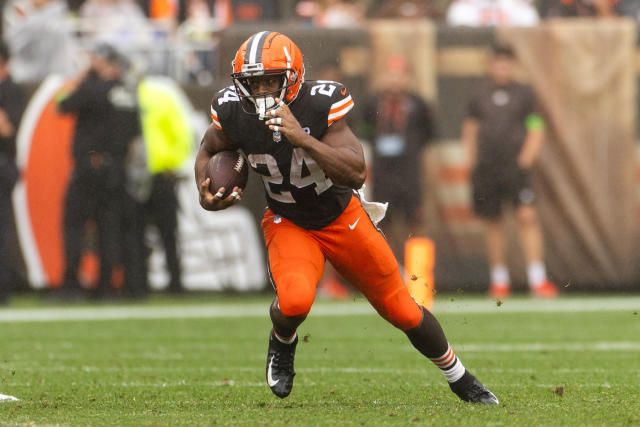
  • Speaking of running backs getting more targets than usual, Nick Chubb had the third-most looks on the Browns in Week 1 with 4 for a 13.79% target share. It was a middling 7.31% mark overall last season, but he finished the last six games at 8.97% with Deshaun Watson after only seeing 6.57% when Jacoby Brissett started the first 11 games. With Kareem Hunt no longer on the team to take passing down work, it could wheels up for Chubb.

Friday, June 30, 2023

2023 NBA Offseason Tracker

It's NBA free agency time! With agreements for the new league year allowed to start coming in today at 3:00 PT, it's time to switch over from the moves over the past week and a half (including trades this morning) to this post that will be updated constantly through the summer. The newest deals will be at the top for the sake of ease, with "Command F" definitely helpful to find certain players as the signings pour in.

Like always, I'll cite who first reported the news (Adrian Wojnarowski, Shams Charania, Chris Haynes, etc) on which day, and I'm projecting reported salaries with the standard 5% and 8% raises for new and incumbent teams, respectively, in bold italics. Figures for existing contracts in trades usually come from Keith Smith on Spotrac, and stats are from Basketball Reference, RealGM, or the NBA's advanced stats page. The visual key consists of my estimates/player options/team options/not fully guaranteed.

With the salary cap officially set at $136,021,000 with a luxury tax line of $165,294,000, the First Apron at $172,346,000 million, and the Second Apron at $182,794,000 million, here are some key figures:
  • The first year of a max salary for a player with six or fewer years of experience is 25% of the cap, so $34,005,250 this season, which means a highest possible total of 4 years, $146,222,575 million if signing with a new team or 5 years, $197,230,450 million with his previous team.
  • The 30% numbers for a player with seven to nine years of experience are $40,806,300 to total 4/$175,467,090 or 5/$236.64 million.
  • For players with 10 or more years, the 35% numbers (I hate the term "supermax") are $47.6 million to total 4/$204.68 million or 5/$236,676,540.
  • If a team is under the First Apron, the full Mid-Level Exception, aka the MLE, is for $12,405,000 and can go up to $53,341,500 over four years.
  • Teams that stay under the Second Apron can use the Taxpayer MLE that was reduced in the new CBA going into effect today, and it can start at $5,000,000 and top out at 2 years, $10.25 million.
  • Teams that operate under the salary cap and then reach it can then use the Room MLE that was boosted in the new CBA to start at $7,723,000 and can now go for 3 years, to total $24,327,450.
  • The Bi-Annual Exception, or BAE, for teams that didn't use it the previous year can start at $4,516,000 and go for a total of 2 years, $9,257,800.
  • Lastly, minimum salaries will range from about $1.1 million for rookies all the way to almost $3.2 million now for those with 10+ years, not too far off of the taxpayer MLE. As always, if a veteran signs just a one year deal at the minimum, he will count the same as a player with 2+ years of experience (about $2 million this year), while earning the full amount.
And now, let the fun begin!

Hart extends with the Knicks: 4 years, $81 million (Woj 8/9)
Josh Hart$12,960,000$18,144,000$19,595,520$21,047,040$22,498,560

Now who could've predicted this exact deal when he picked up his player option back in June? Doing it this way gives New York breathing room under the luxury tax than if they simply agreed on a 5 year, $94.2 million deal in free agency since Hart would have had a $16.2 million starting salary in that case.

8/10 update: Fred Katz reports that the last year is a team option, which is in line with a lot of the Knicks' deals in recent years.

Davis extends with the Lakers: 3 years, "$186 million" (Woj 8/4)
Anthony Davis$40,600,080$43,219,440$52,185,000$56,359,800$60,534,600

Based on the current projection for the 2025 salary cap, this deal would be for about $169 million, which is what I'm projecting above. Like so many of the extensions this summer, the reported number is if the cap raises by the maximum of 10% each year. I believe this involves Davis picking up his $43,219,440 player option for the 2024-25 season in order to tack on 3 years from there.

8/6 update: Scotto adds that the last year of this deal is a player option, and Gozlan noted over the weekend that the last year of Davis' previous contract was technically an Early Termination Option rather than a player option. They are effectively the same, but an ETO can't be declined as part of an extension, which is why it had to be picked up even though that $43.2 million is well short of the projected $49.7 million max next summer that this extension could have otherwise started at.

Temple joins the Raptors: 1 year, minimum contract (Woj 7/31)
Garrett Temple$2,019,706

As Woj noted in his tweet, the take home for Temple is the $3,196,448 minimum for players with 10+ years of experience. It's not the $5,401,000 he could have gotten if New Orleans didn't waive him, but it's good money for a 37 year old who is more known for his locker room presence than on-court contributions at this point.

Antetokounmpo returns to the Bucks (Shams 7/28)
Thanasis Antetokounmpo$2,019,706

I thought that Milwaukee might leave their 15th spot open due to being in the repeater tax for the first time, so kudos to them for continuing to spend, with most likely a one year minimum, as they contend (and keep a certain brother of Thanasis happy).

Brown extends with the Celtics: 5 years "up to $304 million" (Spears/Shams 7/25)
Jaylen Brown$31,830,357$49,700,000$53,676,000$57,652,000$61,628,000$65,604,000

Like with the rookie extensions earlier in the month, the "up to" language used by Marc Spears is carrying a lot of weight since based on next year's currently projected $142 million salary cap, a 35% raise would be for $288.3M, which I have above. Shams noting that there's no player option at the end is likely the other key negotiating point that was resolved. If the cap raises by the highest possible amount of 10%, then it would come out to $303.7M.

Dowtin returns to the Raptors: 1 year, minimum contract (Shams 7/22)
Jeff Dowtin$2,019,706

A training camp deal "with a significant salary guarantee if he makes the opening night roster" is an interesting outcome after Dowtin was a restricted free agent with a two-way qualifying offer. The 26 year old combo guard has done really well in the G League the last two years, and he could fill an area of need. for Toronto.

Dosunmu returns to the Bulls: 3 years, $21 million (Woj 7/21)
Ayo Dosunmu$6,481,481$7,000,000$7,518,519

With a limited market due to restricted free agency, getting a little less than the Room MLE is a solid outcome for the former 2nd round pick. Only 23, Dosunmu now has some financial security just two years into his career and can hit free agency again at age 26. Chicago maintains their strong group of guards while remaining a little under $2 million away from the tax with this deal, which makes it even more unlikely that they use the Disabled Player Exception they received for Lonzo Ball or the rest of their MLE.